Introduction
Retrieval-Augmented Generation has moved beyond proof-of-concept demos into mission-critical enterprise workloads. But the gap between a working prototype and a production-grade RAG pipeline is enormous. In this article, I share patterns and lessons learned from building enterprise RAG systems that serve thousands of concurrent users while maintaining sub-second latency and high retrieval precision.
The core challenge is straightforward: how do you make an LLM reliably answer questions from a corpus of proprietary enterprise documents — contracts, engineering specs, compliance policies — without hallucinating, while serving responses fast enough for real-time interactions?
Architecture Overview
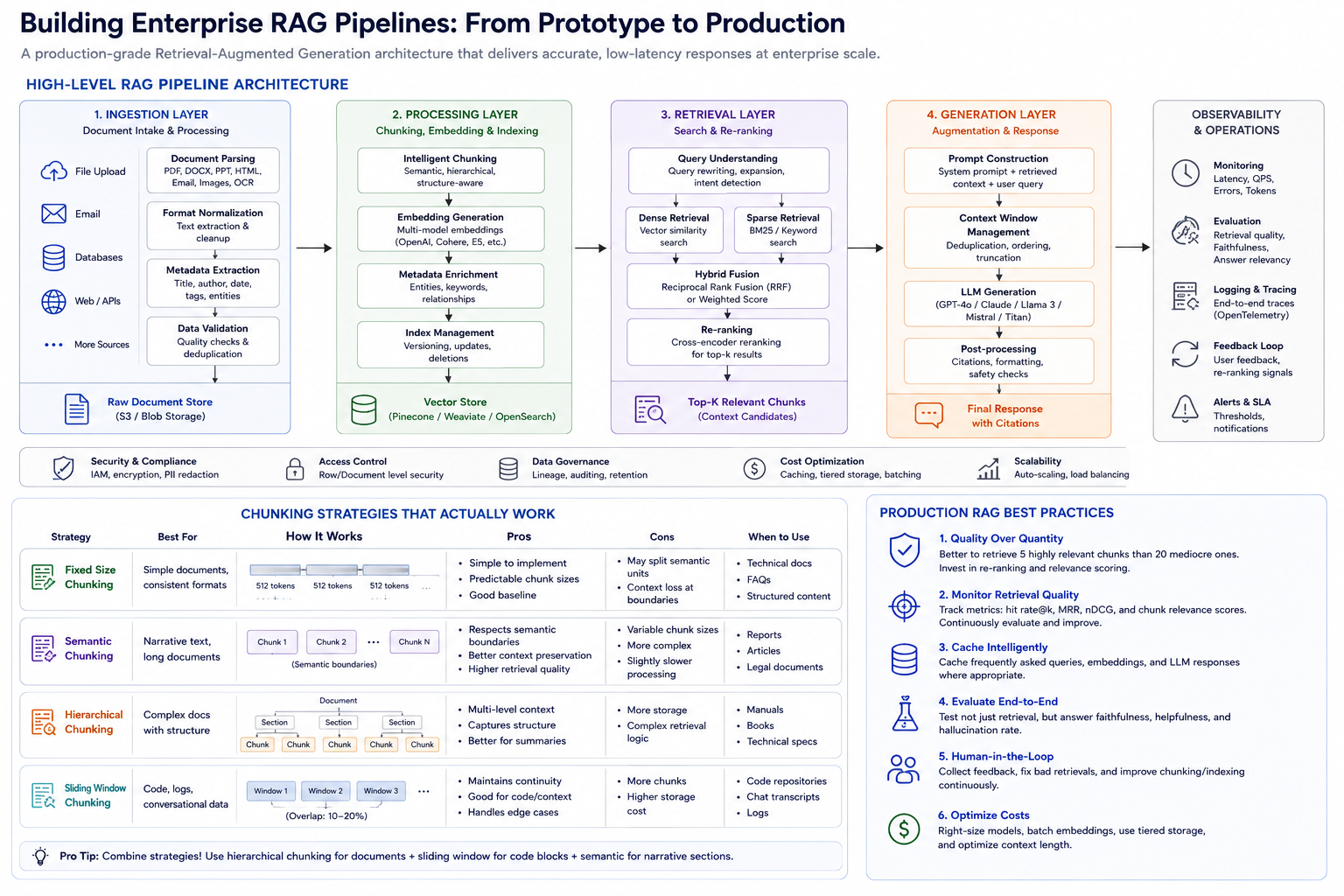
A production RAG pipeline involves far more than a vector database and an LLM. The system I designed for an enterprise knowledge platform processes over 2 million documents across 15 business units, supporting real-time Q&A, document summarization, and compliance checking.
High-Level Pipeline Components
The architecture decomposes into four stages:
- Ingestion Layer — document parsing, format normalization, metadata extraction
- Processing Layer — intelligent chunking, embedding generation, index management
- Retrieval Layer — hybrid search combining dense and sparse retrieval with re-ranking
- Generation Layer — prompt construction, context window management, response synthesis
Chunking Strategies That Actually Work
The most common failure mode in enterprise RAG is poor chunking. Naive fixed-size chunking destroys semantic boundaries and produces irrelevant retrieval results.
Semantic Chunking with Overlap
from langchain.text_splitter import RecursiveCharacterTextSplitter
from sentence_transformers import SentenceTransformer
import numpy as np

class SemanticChunker:
    def __init__(self, model_name: str = "all-MiniLM-L6-v2"):
        self.model = SentenceTransformer(model_name)
        self.base_splitter = RecursiveCharacterTextSplitter(
            chunk_size=512,
            chunk_overlap=64,
            separators=["\n\n", "\n", ". ", " "]
        )

    def chunk_with_context(self, document: str, metadata: dict) -> list[dict]:
        """Split document into semantically coherent chunks with metadata."""
        base_chunks = self.base_splitter.split_text(document)
        enriched_chunks = []

        for i, chunk in enumerate(base_chunks):
            enriched_chunks.append({
                "content": chunk,
                "embedding": self.model.encode(chunk).tolist(),
                "metadata": {
                    **metadata,
                    "chunk_index": i,
                    "total_chunks": len(base_chunks),
                },
            })

        return enriched_chunks
Hierarchical Chunking for Complex Documents
For enterprise documents with deep structural hierarchy — think regulatory filings or technical specifications — flat chunking loses critical context. I use a hierarchical approach:
from dataclasses import dataclass, field

@dataclass
class HierarchicalChunk:
    content: str
    level: int  # 0=document, 1=section, 2=subsection, 3=paragraph
    parent_id: str | None = None
    children_ids: list[str] = field(default_factory=list)
    summary: str = ""

def build_chunk_tree(document: str, headings: list[dict]) -> list[HierarchicalChunk]:
    """Build a tree of chunks preserving document structure."""
    chunks = []
    stack = []

    for heading in headings:
        chunk = HierarchicalChunk(
            content=heading["text"],
            level=heading["level"],
            parent_id=stack[-1].content if stack else None,
        )

        while stack and stack[-1].level >= heading["level"]:
            stack.pop()

        if stack:
            stack[-1].children_ids.append(heading["text"])

        stack.append(chunk)
        chunks.append(chunk)

    return chunks
This approach enables parent-context retrieval: when a chunk matches a query, we can include its parent summary to provide broader context without consuming the entire context window.
Hybrid Search Architecture
Pure vector similarity search struggles with enterprise queries that contain specific identifiers, dates, or technical terms. The solution is hybrid search combining dense retrieval (embeddings) with sparse retrieval (BM25/keyword matching).
Implementation with Re-ranking
interface SearchResult {
  documentId: string;
  content: string;
  score: number;
  source: "dense" | "sparse";
}

interface RerankedResult extends SearchResult {
  finalScore: number;
  relevanceExplanation: string;
}

async function hybridSearch(
  query: string,
  topK: number = 20
): Promise<RerankedResult[]> {
  // Execute both retrieval paths in parallel
  const [denseResults, sparseResults] = await Promise.all([
    vectorStore.similaritySearch(query, topK),
    bm25Index.search(query, topK),
  ]);

  // Reciprocal Rank Fusion to combine results
  const fused = reciprocalRankFusion(denseResults, sparseResults, {
    denseWeight: 0.6,
    sparseWeight: 0.4,
  });

  // Cross-encoder re-ranking for precision
  const reranked = await crossEncoderRerank(query, fused.slice(0, 10));

  return reranked;
}
Why Reciprocal Rank Fusion?
Reciprocal Rank Fusion (RRF) outperforms simple score normalization because it is robust to the different score distributions produced by dense and sparse retrievers. The formula is simple:
- For each result, compute
1 / (k + rank)wherekis a constant (typically 60) - Sum the RRF scores across all retrieval methods for the same document
- Sort by combined RRF score
In our production system, hybrid search with RRF improved Mean Reciprocal Rank by 23% over pure dense retrieval and reduced "no relevant result" outcomes by 41%.
Context Window Management
Enterprise queries often require information from multiple chunks. Naive concatenation wastes context tokens and can confuse the LLM.
Token-Aware Context Assembly
import tiktoken

def assemble_context(
    retrieved_chunks: list[dict],
    max_context_tokens: int = 6000,
    model: str = "gpt-4"
) -> str:
    """Assemble retrieved chunks into a context string within token budget."""
    encoder = tiktoken.encoding_for_model(model)
    context_parts = []
    current_tokens = 0

    for chunk in retrieved_chunks:
        chunk_tokens = len(encoder.encode(chunk["content"]))

        if current_tokens + chunk_tokens > max_context_tokens:
            break

        context_parts.append(
            f"[Source: {chunk['metadata']['source']}]\n{chunk['content']}"
        )
        current_tokens += chunk_tokens

    return "\n\n---\n\n".join(context_parts)
Production Considerations
Monitoring and Observability
Three metrics matter most in production RAG:
- Retrieval precision — percentage of retrieved chunks actually relevant to the query
- Answer faithfulness — percentage of generated claims supported by retrieved context
- Latency P95 — end-to-end response time at the 95th percentile
We instrument these with custom evaluators that sample production queries and run automated assessments using a separate LLM judge.
Scaling to Millions of Documents
At enterprise scale, the vector index becomes a bottleneck. Our architecture uses:
- Hierarchical Navigable Small World (HNSW) indices with product quantization for memory efficiency
- Namespace partitioning by business unit to reduce search scope
- Tiered indexing with hot/warm/cold document tiers based on access frequency
Lessons Learned
After deploying RAG pipelines across three enterprise platforms, the biggest insights are:
- Chunking quality trumps embedding model quality — a mediocre model with excellent chunking outperforms a state-of-the-art model with naive chunking
- Metadata filtering reduces hallucination — pre-filtering by document type, department, or date range dramatically improves precision
- Evaluation is harder than implementation — building automated evaluation pipelines for retrieval quality is a project unto itself
- Users need confidence signals — displaying source citations and confidence scores builds trust faster than any accuracy improvement
Conclusion
Production RAG pipelines demand thoughtful engineering across the entire stack — from document ingestion to response generation. The patterns described here have been validated across systems serving enterprise-scale workloads with strict latency and accuracy requirements. The key is treating RAG as a distributed systems problem, not just an AI problem.